We have been speaking of “the teachings of wisdom” and we have been trying to see the work of love in the light of these teachings. We have been trying to understand the work of love as the task of supporting each other’s search for the life of meaning that wisdom tells us is possible and necessary for humanity.
The flash and glory of falling in love can awaken us, body and soul, to a great unknown within ourselves. But when we live together and face the day-to-day details of life, the continual pressures and complications, the fears and resentments, the disappointments and the strangely hollow triumphs, the everydayness of it all, the physical, emotional, and mental labyrinth of “life itself,” how can we go on loving each other in a way that is more than only a yearning for another beginning? Another beginning of love, a beginning that, like all human processes, must inevitably come to a crossroads where something intentional and conscious is needed. To be “romantic,” in the derogatory sense of the word, is to turn away again and again from the crossroads of the process of love, the place where what is automatically given to us by nature must be joined by something intentional from ourselves. To be romantic, in the derogatory sense, is to yearn only for automatic love. But the work of love begins where automatic love ends.
The wisdom teachings do not speak much of automatic love, or about what we nowadays call “relationships.” This is so much so that one might even wonder if men and women of other cultures and worlds experienced anything like the difficulties and rewards that are part of intimate relationships in our culture. In fact, it is probably true that in our industrial and postindustrial society, with all the social changes that have been wrought by technology, the psychological demands of living together are startlingly different in many respects.
But that is not the main point. The point is that when the traditions of wisdom speak about love, they are speaking almost without exception of love that is intentional love “at the crossroads” and beyond. Confusion enters in mainly because the love spoken of by wisdom is mistakenly viewed as existing on the same level as automatic love. It is a serious error to confuse the kind of love that is given to us by nature with the kind of love we must work for. And, of course, we will never even imagine the work of love if we assume that the higher forms of love are on the same level as the love that is given to us automatically.
-Excerpt from The Wisdom of Love

September 07 2010 | Uncategorized | No Comments »
And what we are seeking is a body, a life on earth, in which our actions and behavior serve the higher impulses and intentions, the higher feelings, that constitute the heart of true human virtue. We are not simply searching for an improved version of moralist automatism nor for childish self-assertion masquerading as freedom. In a breathtakingly real sense, we are searching for a new kind of body, a body that has a new aim, a new purpose: voluntarily to serve the Good. And, to compound the mystery, in the search for a new kind of body within ourselves, there exists the possibility of discovering a new heart, source of love within ourselves that we have perhaps glimpsed within our lives, as in the legends where the seeker or the hunter has but one fleeting glimpse of a serenely beautiful face or a great winged being-a glimpse which, when understood, has the power to change entirely the direction of one’s life.
- Excerpt from Why Can’t We Be Good

April 23 2010 | Uncategorized | No Comments »
To us, the phrase “self-knowledge” means little more than “psychologizing” about ourselves; that is, obtaining emotionally stimulating opinions about ourselves, against the background of the view of human nature insinuated into us by our own abnormal social order.
Or it means conceptual analysis, which cannot penetrate into our emotions and body because the faculty of thinking itself is encapsulated within us. Thoughts about myself have no penetrating action upon the emotions and instincts.
Socratic self-knowledge is self-attention, which is a force that can exist and act with tremendous power within ourselves. For Socrates, it develops and grows in relationship to the various functions of the whole human structure, in the midst of the “citizens of Athens,” in “the marketplace.”
- Excerpt from The Heart of Philosophy

Tags: Jacob Needleman, self-attention, self-knowlege, The Heart of Philosophy
March 24 2010 | Uncategorized | No Comments »
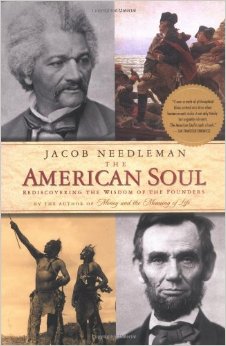
America – the physical, actual America that we see and live in – this America needs to be understood not as in itself sacred but as a privileged, temporary corner of “the world” where men and women are granted the liberty to search for truth and the life within. Behind all the political and economic machinations of the Founders of this country, there existed in their minds and hearts the passion to create “an American place” in the midst of the world, where the Good can be sought and lived. They believed there existed the Good – some called it God, others called it Reason – and that the Good – could enter human life. Of course, political freedom exists now in many countries of the world, often due to the influence of American ideas, but we will never “know what we have here” if we do not understand that the founding basis of this country was not land or tribe, but the call for people to assemble together and work together for the Good. Perhaps America’s people no longer come together for this purpose; perhaps political liberty and the great rule of law serve now only to protect the cravings for meaningless comfort and meaningless power; perhaps the nation’s physical strength seduces us into imagining that physical strength is true strength, that physical safety is true safety, that external freedom is true freedom, external democracy the true equality of people. If so, if we believe that the outer America is the real America, we are deceived by ourselves, and as the prophets of Israel warned, we are certain to perish – first inwardly and then outwardly.
- Excerpt from The American Soul

Cover of The American Soul
Tags: America, Jacob Needleman, Needleman, Spirituality, The American Soul
March 16 2010 | Uncategorized | No Comments »
The growing human being—child or adult—has need for ideas that nourish the search for Truth and the development of the Will to the Good, that nourish the sense of the sacred in nature and, above all, in ourselves. It may not be necessary for everyone to enter the path of inner work, leading to the opening to the true I Am within. But it may very well be necessary for the doors to be open to those who are touched by the great wish that leads to the personal search for God, whether that search takes place in the hidden heart of our own ancient teachings; or in the still living practical mysticism of Eastern teachings; or in the re-discovered path leading to the awakening of Conscious Attention; or in ways still, for all we know, hidden and waiting to be “switched on” in our civilization.
Both in our Earth and in our personal lives—we are perhaps at an unimaginably critical juncture in the life of man on Earth.
We cannot wait for very long. The time remaining is very short, is it not?
*
June 06 2009 | Uncategorized | No Comments »
More and more, as I see it now, this heartless way of thinking about God and ultimate reality dominates the mind of the contemporary world. For God or against God, “belief” or “atheism,” it makes no difference unless the inner yearning—or whatever we wish to call the cause and source of the “second breathing”—is there. And it can so easily be there, just as it can so easily be covered over and ignored, perhaps for the rest of one’s life. God or not God, “belief” or “science”—it also makes no real difference for my personal life unless the call of the Self and its need to “breathe” is heard and, ultimately respected. Not only can thought about ultimate reality make no difference to the world or to my personal life unless we hear and respect the call of the Self, but such empty thought can bring down our personal and collective world, even our Earth itself. When thought races ahead of Being, a civilization is racing towards destruction.
June 03 2009 | Uncategorized | No Comments »
Introduction
To think about God is to the human soul what breathing is to the human body.
I say to think about God, not necessarily to believe in God—that may or may not come later.
I say: to think about God.
I clearly remember the moment something deep inside me started breathing for the first time. Something behind my thoughts and my desires and fears, something behind my self, something behind “Jerry,” which was and is my name, the name of me, from my earliest childhood.
I can say this now, more than sixty years after my first conscious experience of this second breathing, this first breathing of the soul.
Let me explain.
Tags: "What Is God?"
April 24 2009 | Books | 1 Comment »
For nearly decades Jacob Needleman has confronted the central questions of our era in light of the vision that lies at the root of the world’s great spiritual traditions. Needleman’s work it takes topics that exist in disparate threads throughout our culture—new religions, esoteric Christianity, the founding mythos of America—and frames them in a manner both sensible and deeply questioning. Needleman calls forth the human meaning hidden in virtually every aspect of our modern lives.
Mitch Horowitz at Parabola recently sat down with him to discuss the nature of consciousness and its relationship to the body. Amid the current talk of “quantum fields” and “consciousness studies,” Needleman returns us to the heart of the matter: Should the mind and body be understood as two aspects of one thing, or as two distinct realities? And what does this mean for our sense of ourselves?
Read the Interview (PDF, 800KB).
Tags: Consciousness, Philosophy
March 01 2009 | Interviews | Comments Off
Goodrich Lecture
Indian Springs School
Jacob Needleman
January 22, 2004
THE ONE GREAT QUESTION
I think I should start by saying what I think a philosopher is. As some of you probably know, it means a “lover of wisdom,” somebody who seeks wisdom, who searches for wisdom—in that sense of love as the deep desire for something you do not have, but which you wish for more than anything else. And to say of someone they’re a professional philosopher is very uncomfortable for me because it’s a little like saying someone is a professional lover. Read More (PDF, 130KB).
Tags: Philosophy
March 01 2009 | Articles by Jacob Needleman | No Comments »
Next »